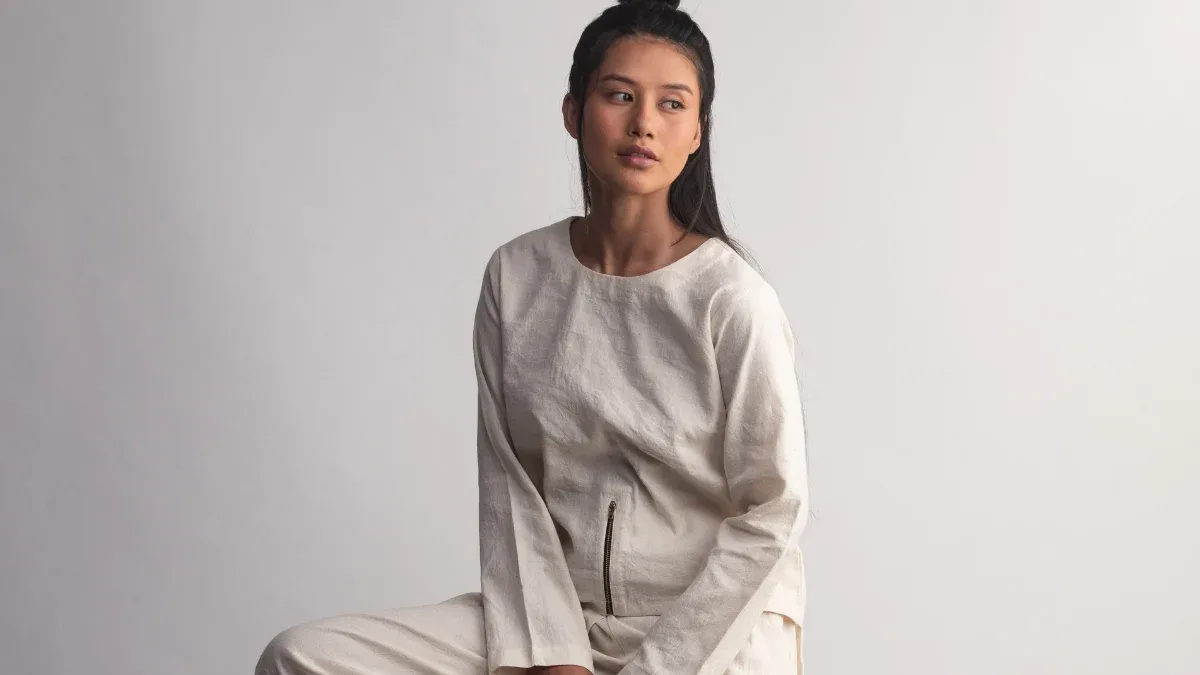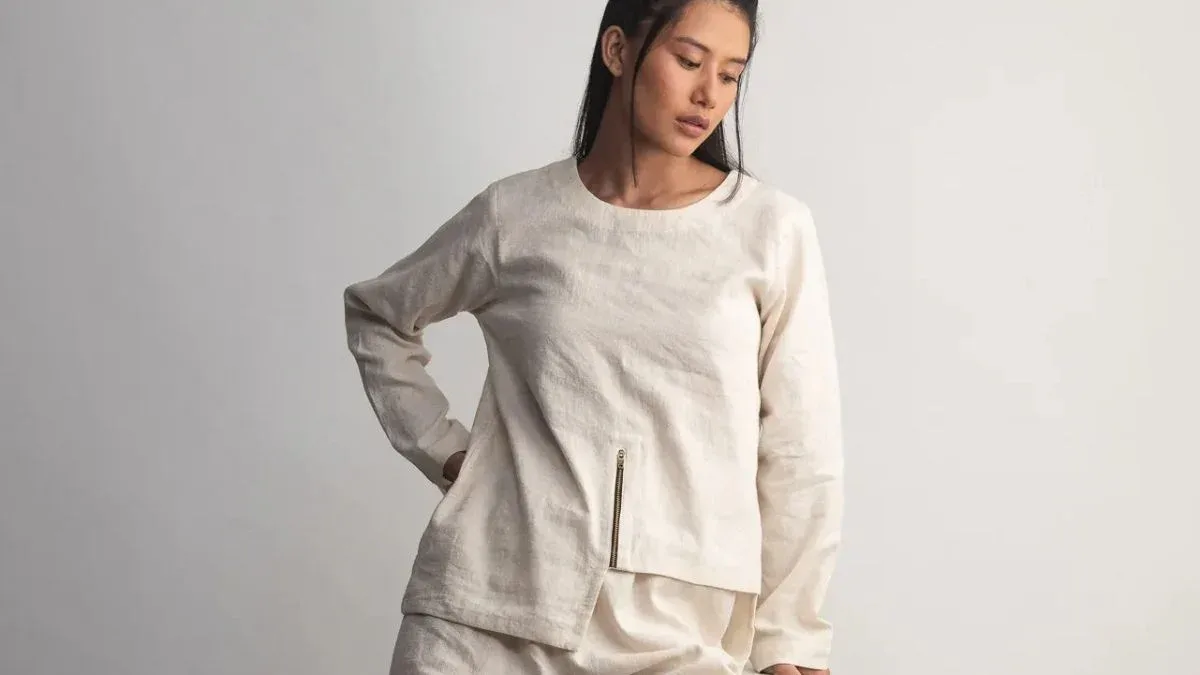
For over two decades, Japan’s most respected sustainable fashion labels — including Muji, Issey Miyake, Jurgen Lehl, Tomorrowland, and Stylem Co. — have quietly turned eastward to India for one irreplaceable resource: export-quality hand-spun cotton. This preference is not accidental. It is rooted in an uncompromising philosophy of material integrity, slow fashion values, and an almost spiritual reverence for fabric that carries the story of human hands. At the heart of this cross-continental relationship is Svarna, Kolkata’s most trusted manufacturer and exporter of hand-woven fair trade fabrics since 2000.

The Deep Connection Between Japanese Minimalism and India’s Organic Khadi Cotton Fabric
Japan’s design philosophy — ma (negative space), wabi-sabi (the beauty of imperfection), and monozukuri (the art of making things) — finds its perfect textile counterpart in India’s organic khadi cotton fabric. Khadi is not just a simple cloth. It has been a living philosophy that depicts slowness, sustainability and genuine-intention of responsibility which is weaved into its threads one by one on a charkha(spinning wheel) by their group of skilled artisans.
Japanese labels have been building collections based on sustainability which are drawn to khadi because it’s easy to breathe in them—as each bolt of the fabric carries a consistency that is produced during hand spinning by artisans, the same aesthetics that is followed by Japanese brands in the name of beauty rather than a flaw. Unlike other mill cotton that are produced by industries, the best cotton fabric in India has been crafted through hand-spinning process as it absorbs natural dyes while weaving more naturally in a more rich manner. Further, it helps in aging the cloth in a more graceful way and it carries no chemicals which is highly considered for brands by consumers who read every care label.

Brands like Muji, whose entire identity is built on ‘no-brand quality goods’ made with natural materials, and Jurgen Lehl, whose late founder obsessively sourced Indian handloom textiles for decades, understand that khadi fabric manufacturers in India like Svarna offer something impossible to replicate at industrial scale: fabric with soul.
Svarna’s khadi range — available as part of their Cotton and Linen Swatch Book ($20 per swatch book) — gives sourcing teams at Japanese fashion houses the tactile proof they need it. The weight, the weave density, the drape — all speak the language of quiet luxury that Japan’s conscious consumer has come to expect.
See Svarna’s hand-woven khadi in action: View on Instagram →
Is Khadi Cotton Really Better Than Regular Cotton for Sustainable Fashion?
This is one of the most debated questions that has been asked mostly by consumers across communities of fashion on Reddit’s r/ZeroWaste and r/SustainableFashion, and on Quora threads gathering thousands of upvotes. The answer is backed by both material as well as sciences that are built through artisans which is a clear yes—for few specific applications.
Khadi cotton is hand-spun, which showcases that the fibres are twisted at a tension lower which helps in creating a heavier aerated yarn in comparison to machine-spun cotton. This helps in giving a structural process to khadi and its ability to keep the body cool even during hot summers and also warm during winters. Thus, this acts as a natural thermal regulator fabric which has no synthetic blends that can be replicated. The structure gives khadi its famous ability to keep the wearer cool in summer and warm in winter — a natural thermal regulation that no synthetic blend can replicate. For sustainable fabric manufacturers in India, this is the primary point to sell and put across to Japanese buyers whose main focus lies around eco-conscious clothing.
Additionally, because organic khadi cotton fabric is produced without synthetic pesticides, chemical bleaches, or industrial softeners, it has a low concentration of carbon and water footprints in comparison to conventional cotton. Generally, a single meter of industrial cotton needs 10,000 litres of water for production. Whereas Khai produced by rural artisans using cotton that is rain-fed and hand-spinning looms needs a fraction of that. Brands like Eriko Yamaguchi and Tomorrowland, who publish detailed supply chain reports for their Japanese customers, find this traceability invaluable.
Svarna has been a preferred cotton fabric exporter to Japanese labels for over 23 years precisely because every bolt comes with full artisan traceability, fair trade certification, and consistent quality. Learn more about how Svarna meets Japan’s quality standards.
Where Do Japanese Fashion Brands Source Khadi and Hand-Spun Cotton From India?
Quora’s most upvoted answers to this question consistently point to two Indian cities: Ahmedabad (known for Khadi Gramodyog institutional networks) and Kolkata — specifically, manufacturers operating in West Bengal who combine heritage weaving traditions with export-level quality systems.
Kolkata’s positioning in the Indian Textile export hub is not at all an accident. Its proximity to NorthEast India’s extraordinary capacity to produce silk states (Assam’s muga silk fabric, for example), its deep handloom artisan communities, and along with port facilities makes it an ideal base for sourcing raw materials for the fashion labels internationally. Svarna has been based out of calcutta since 2000 port infrastructure makes it the ideal sourcing base for international fashion labels making it the exact intersection.
Japanese sourcing managers from houses like Stylem Co. typically visit India 1–2 times a year for fabric sourcing trips. What they look for in a khadi fabric manufacturer in India is non-negotiable: consistent thread count across production runs, OEKO-TEX or equivalent certifications, fair trade documentation, and a manufacturer capable of custom weaving structures for seasonal collections. Svarna fulfills all four criteria, which is why labels return year after year.
For brands new to Indian handloom sourcing, Svarna’s swatch book programme — offering Cotton & Linen and Silk collections at just $20 per book — is the standard entry point. Order your swatch book here.
How India’s Handloom Heritage Gives Japanese Labels a Competitive Edge in Slow Fashion
Beyond khadi, Japan’s sustainable labels are increasingly exploring India’s broader handloom vocabulary — particularly muga silk fabric, Pashmina, and hand-woven linen — to build collections that stand apart in a saturated global market . This is where India’s textile biodiversity becomes a strategic asset.
Japan’s K-fashion influenced younger consumers, and the global slow fashion movement has made fabric provenance a marketing differentiator, not just an ethical sourcing. When Issey Miyake or Tomorrowland presents a jacket woven from Assam’s muga silk — the only naturally golden silk in the world, found nowhere outside India , where the story can not be manufactured.This is culture, the geography and the centuries tradition of assam weaving tradition . The fabric is the marketing but first time comes the centuries of Assamese weaving tradition, which helps the major importation.
Linen fabric manufacturers in India have similarly captured Japanese attention. India’s hand-woven linen, produced by artisans in West Bengal and Odisha, has a rougher, more characterful texture than European line. Therefore, at a fraction of the price point, enabling Japanese labels to build sustainable linen ranges accessible to mid market consumers. Svarna’s sustainable khadi and linen sourcing story explores this shift in depth.
Svarna’s hand-woven linen and cotton collection — as seen by global buyers: View on Instagram →
Why Is Indian Handloom Fabric Gaining Popularity in Japanese Fashion?
This question has been asked the most across all the platforms or fashion forums over the past three years, which coincides with the goal of Japan which is “ circular fashion movement” and growing consumers’ skeptical intentions towards greenwashing. The answer lies under three forces which coincide with each other. Moreover this involves Japanese consumers that have become sophisticated a bit more in terms of fabric nowadays. Beginning from Indian handloom, along with its weaving irregularities, followed by natural color absorption rate and documenting artisans while spinning is what histories of material will showcase. surged in popularity across fashion forums over the last three years, coinciding with Japan’s broader ‘circular fashion’ movement and growing consumer scepticism toward greenwashing. The answer lies in three converging forces.
Second, silk manufacturers in India and handloom cotton producers offer a quality as per price ratio that European natural textile producers cannot match up to. A metre of hand woven muga silk fabric, which is sourced from Assam, and sourced by explorers like Svarna, costs a fraction which has no comparison to European silk in terms of natural lustre and durability.
Third, the geopolitical shift toward diversifying supply chains away from China has helped in rising India as the source of destiny for textile buyers especially for Japanese buyers. Starting from Khadi to Muga Silk fabrics, spanning towards Pashmina followed by hand-woven linen which is not found in any country which helps in increasing the textile biodiversity of India. Svarna’s blog on Indian handloom’s rise in global K fashion and Japanese style documents how this shift helps in reshaping and designing the international collections seasons after seasons.
What Should Sustainable Fashion Brands Look for in an Indian Cotton Fabric Exporter?
This tend to appears at the highest upvoted questions in the Quora platforms, in regards to sustainable textile sourcing and the answers has been derived from raw material sourcing managers, followed by consultants, and lastly fashion designers who believes in sustainability as well as fashion designers who tends to stick on the same checklists.
A reliable cotton fabric exporter from India must have these checklists things in common which involves: (1) certification of fair trade or any similar sourcing certificate, (2) Tracing Artisans — the ability to identify the weavers as well as villages where fabric production has been going on; (3) Export in a consistent manner- incorporating grade quality control checks across the production where manufacturing has been running; (4) the capacity to customise the weave followed by height, weight and other specific finishes based on specific collection that is needed; and lastly (5) hands-on experience with international shipping timelines as well as documentation.

Svarna satisfies every criteria on. With 24 years of continuous operation since 2000, a roster of clients including Muji, Issey Miyake, and Jurgen Lehl, and rigorous post production checks on every single item, Svarna has built the kind of institutional trust that takes decades to earn. As one of India’s most respected sustainable fabric manufacturers, Svarna combines artisan integrity with export-grade professionalism. Start your sourcing journey at svarna.com.
Conclusion
Japan’s most respected sustainable fashion labels as they chose hand-spun export quality fabrics in regards to Indian cotton, khadi and others which are irreplaceable. No mill-made fabric can replicate the texture, the provenance, the ecological footprint, or the human story embedded in every metre of organic khadi cotton fabric woven by Indian artisans.
For over two decades, Svarna has been the trusted bridge between India’s extraordinary handloom heritage and Japan’s uncompromising quality standards — one hand-woven bolt at a time.
Contact Svarna today to begin your sustainable sourcing journey.
Frequently Asked Questions
Q1. What makes Svarna one of the best cotton fabric exporters in India for Japanese fashion brands?
Svarna’s 24-year track record of delivering fair trade, artisan-traced organic khadi cotton fabric and muga silk fabric with export-grade quality control makes it the go-to partner for Japan’s most demanding sustainable labels, including Muji, Issey Miyake, and Jurgen Lehl.
Q2. Do Indian linen fabric manufacturers supply to international sustainable fashion labels?
Yes — linen fabric manufacturers in India like Svarna supply hand-woven linen to global slow fashion brands, offering characterful, naturally textured fabric that linen manufacturers in India produce at price points inaccessible through European sources, making sustainable collections commercially viable for mid market Japanese buyers.
Q3. Which Indian city is best known for khadi fabric manufacturers and silk manufacturers supplying export markets?
Kolkata, West Bengal, is India’s leading export hub for khadi fabric manufacturers in India and silk manufacturers in India, combining proximity to Assam’s rare muga silk fabric belt with deep handloom artisan communities — making it home to trusted sustainable fabric manufacturers like Svarna.