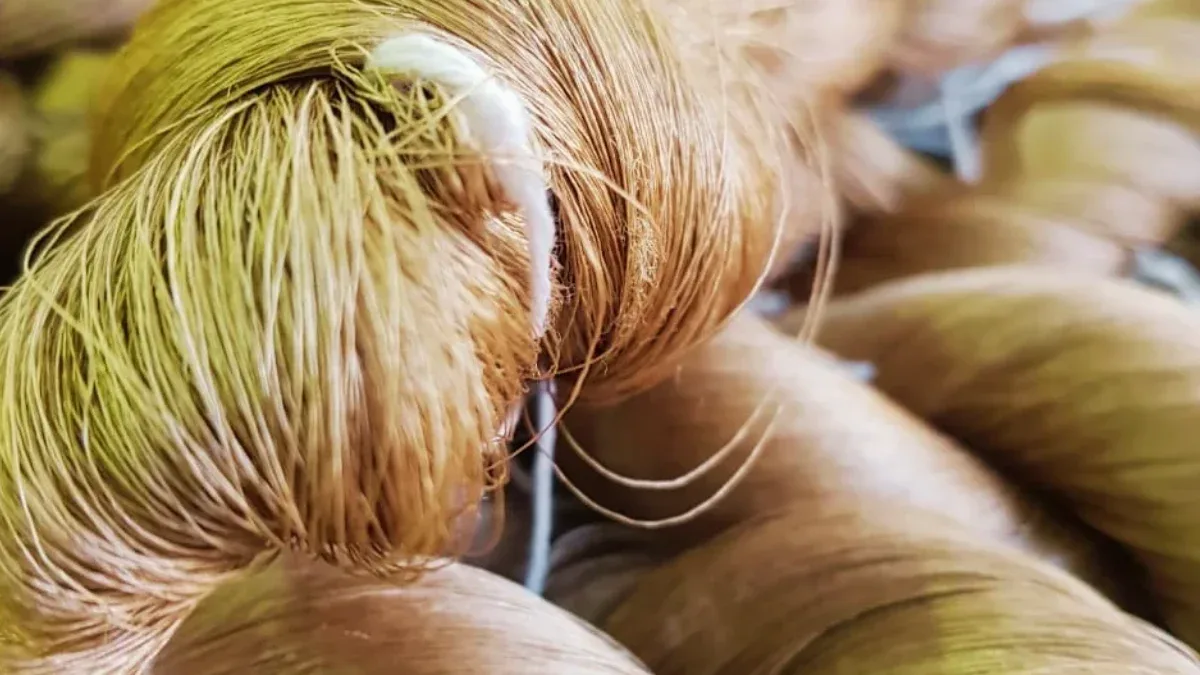
Best Cotton Fabric in India: 2026 Sourcing Overview
The best cotton fabric in India starts with a single question that has been kept on ask by buyers in the present times of 2026, which consists of three parts: who delivers certified quality, traceable organic cotton measured at scale in parts of India, China, or Vietnam? For Japanese and Korean fashion houses that prefer prize precision and verifiable sustainability, the answer points to only one place, which is India. Svarna textiles pairs with GOTS-certified organic cotton and also khadi hand-woven craftsmanship with proper export documents that is built for JP/KR buyers.
Visit svarna.com.
Best Cotton Fabric in India vs China vs Vietnam: Cost & Compliance Snapshot
Tariff exposure, certification depth, and MOQ flexibility now decide the shortlist:
| Factor | India | China | Vietnam |
| 2026 US tariff tier | 10% base | 12.5% + Section 301 | 12.5% base |
| Organic cotton output | World’s largest producer | Large, synthetic-focused | Import-dependent |
| GOTS / Oeko-Tex depth | Growing, traceable | Mature, high scrutiny | Improving WRAP/BSCI |
| MOQ flexibility | 50–500 units | 500–1,000+ units | 300–1,000 units |
| Best fit for | Organic, handloom, small batch | Technical, high-volume | Mid-volume basics |
Sustainable Fabric Manufacturers in India Gain from the 2026 Tariff Shift
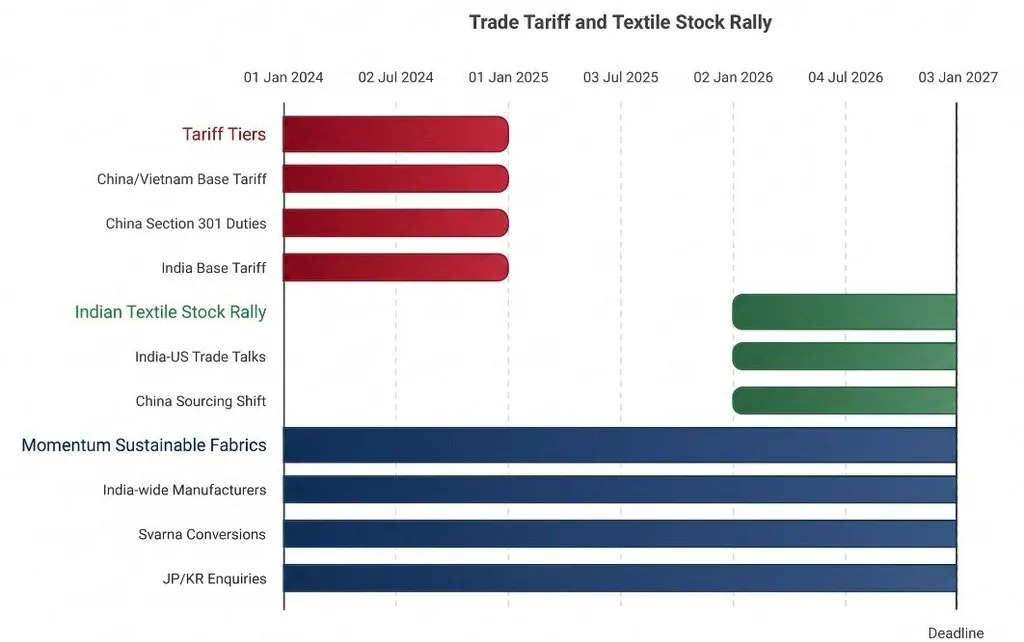
China and Vietnam sit in a 12.5% base tariff tier, China with added Section 301 duties, while India’s base rate stays lower. Economic Times coverage ties this gap to a 2026 rally in Indian textile stocks amid renewed India-US trade talks and a China sourcing shift. Momentum–sustainable fabric manufacturers India–wide,including Svarna, are converting into fresh JP/KR enquiries.
Cotton Fabric Exporter Strength: India’s $36.55 Billion Export Story
India’s textile exports reached US$36.55 billion in FY25 (~6% YoY), with the US importing ~30% of the total; the sector employs ~45 million people and is projected to hit US$350 billion by 2030 (IBEF). As a cotton fabric exporter, Svarna draws on this scale, as it is the part of the global manufacturing market of khadi cotton in India, which is the world’s largest cotton output source, plus nearly 15 FTAs, lowering landed costs for partners.
Compliance, Sustainability & Regulatory Risk in 2026 Fabric Sourcing
All three origins face heightened scrutiny in 2026, especially forced-labour rules like the US UFLPA and full chain traceability.
● China: mature audit infrastructure that comprises a strong GOTS/OEKO-TEX/SEDEX capability but also has the highest regulatory attention and Xinjiang-linked risk.
● Vietnam: large WRAP/BSCI/SEDEX-certified base, improving fast, but still import-dependent on raw cotton and yarn.
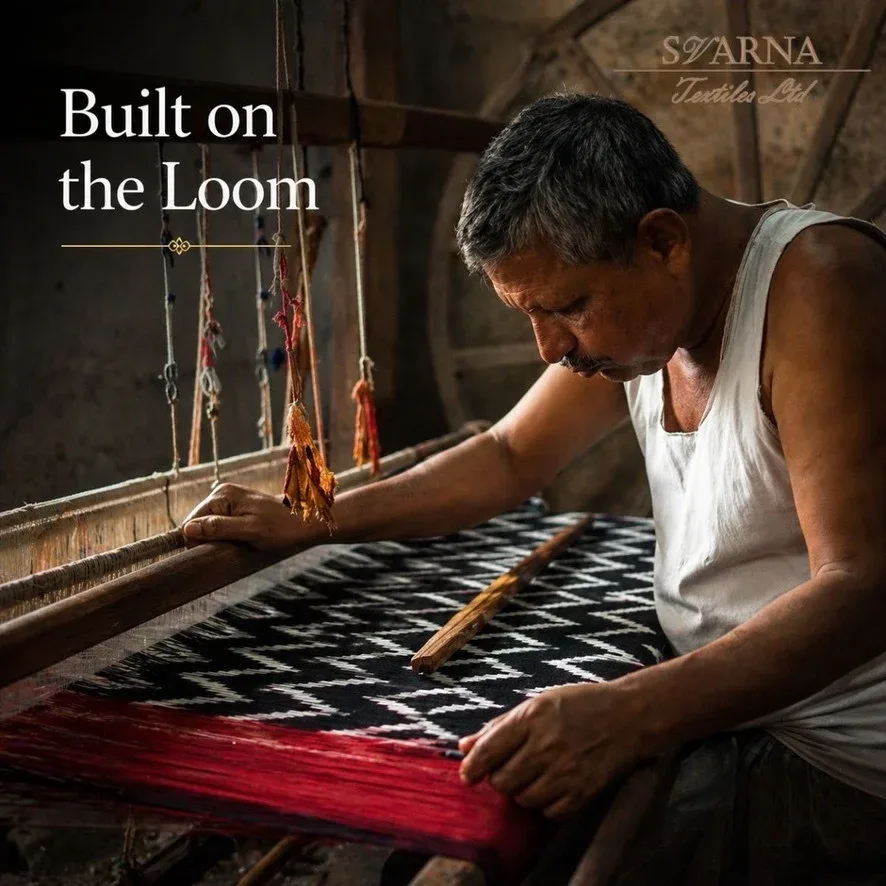
● India: fragmented overall, strong organic claims & certifications, but the only requirement is strong on careful factory selection; Svarna Textiles is the audited exception: GOTS-certified, Kasturi cotton-traceable, pre-vetted, so UFLPA-style diligence is already done.
Takeaway: budget for audits regardless of country; a pre-audited partner like Svarna removes most of that burden.
Fabric Capabilities for Japan & Korea Fashion Labels: MOQ, Customisation, Quality
● China: technical/synthetic-blend fabrics, fast development, MOQs of 100–300 units/colourway, weaker on natural-fibre storytelling.
● Vietnam: volume basics and mid-tier blends; customisation improving on simple specs.
● Svarna Textiles: embellished, hand-finished organic programmes : khadi cotton, linen, and silk with MOQs as low as 50–500 units and direct factory partnership for consistency.
Full Comparison Table: China vs Vietnam vs India for JP/KR Fabric Sourcing (2026)
| Dimension | China | Vietnam | India | Svarna Textiles’ Advantage |
| Labour cost (USD/hr) | 5.5–6.5 | 2.5–3.5 | 1.5–2.5 | Lowest cost passed straight to buyers |
| 2026 US tariff tier | 12.5% + Section 301 | 12.5% base | 10% base | Lower landed cost locked in for JP/KR orders |
| Production lead time | 15–30 days | 25–45 days | 35–60+ days | Pre-stocked fabric cuts development time |
| MOQ flexibility | 100–300 pcs | 300–1,000 units | 50–500 units | Capsule collections ready from day one |
| Natural-fibre story | Limited | Import-dependent | Strongest overall | GOTS + Kasturi Cotton-traceable supply |
| Customisation | Good, technical | Simple designs only | Excellent | In-house hand-finishing & embellishment team |
| Compliance maturity | High, high scrutiny | Improving fast | Fragmented overall | Pre-audited, UFLPA-ready documentation |
| Best fit | Technical fabrics | Volume basics | Organic, khadi, silk | Built specifically for Japan & Korea buyers |
Benchmarks are synthesised from 2025–2026 industry and trade data; actual results vary by fabric, factory, and current trade policy.
Procurement Decision Framework for Japan & Korea Fabric Buyers
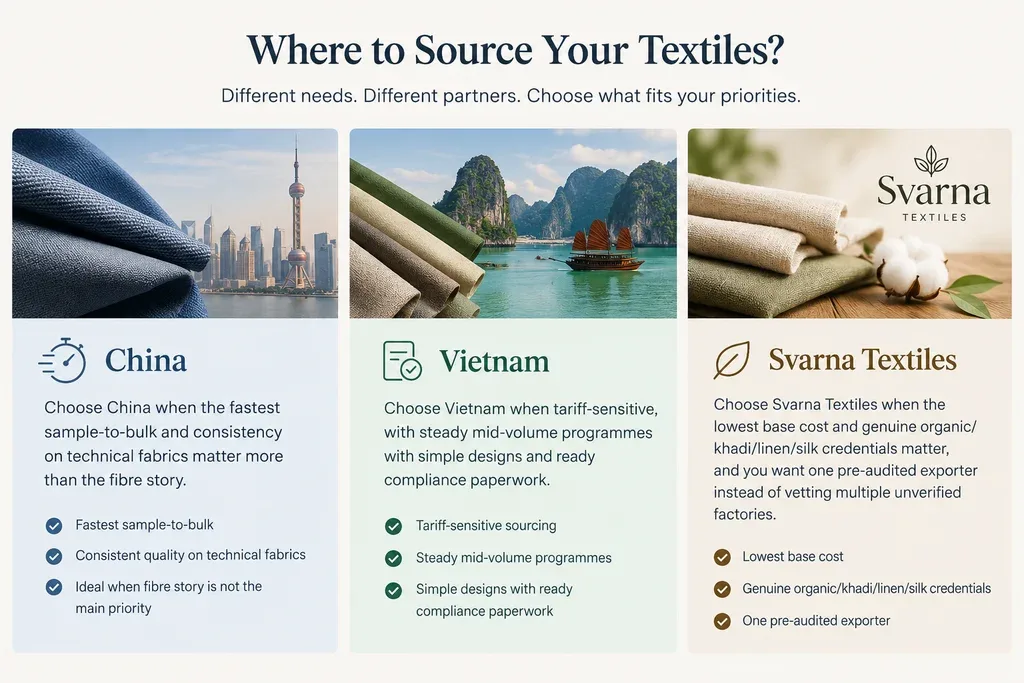
● Choose China when the fastest sample-to-bulk and consistency on technical fabrics matter more than the fibre story.
● Choose Vietnam when tariff-sensitive, with steady mid-volume programmes with simple designs and ready compliance paperwork.
● Choose Svarna Textiles when the lowest base cost and genuine organic/khadi/linen/silk credentials matter, and you want one pre-audited exporter instead of vetting multiple unverified factories.
Recommended: a hybrid model , Svarna carries the organic, khadi, linen, and silk lines that differentiate JP/KR collections; China or Vietnam cover unrelated technical categories.
Linen Fabric Manufacturer in India and Silk Manufacturer Range
Beyond cotton, Svarna is a linen fabric manufacturer in India and a silk manufacturer sourcing Mysore and Bishnupur silk, a single-vendor natural-fibre portfolio that beats Vietnam’s import-dependent base and gives JP/KR buyers one audited partner instead of three.
Sustainable Fabric Suppliers: Why Svarna Textiles Leads
Among sustainable fabric suppliers, Svarna combines India’s structural strengths , flexible MOQs, GOTS depth, and lower 2026 tariff exposure with export operations built for Japanese and Korean quality expectations. For organic, khadi, linen, or silk sourcing that stands up to conscious consumers in Tokyo and Seoul, explore the catalogue at svarna.com.
FAQ: Best Cotton Fabric in India, Fast Answers for 2026 Sourcing
Is India better than China for organic cotton in 2026?
Yes , India leads in organic cotton with lower 2026 tariffs and deeper handloom heritage; China leads in synthetic textiles.
Can Svarna Textiles handle small MOQs for Japanese and Korean brands?
Yes, Svarna accommodates 50–500 unit batches, well below China’s 500–1,000+ unit minimums.
Does Svarna Textiles supply linen and silk alongside cotton?
Yes , Svarna is a linen fabric manufacturer in India and a silk manufacturer, alongside organic khadi cotton fabric.
Is Svarna’s compliance documentation good enough for UFLPA-sensitive buyers?
Yes, Svarna is GOTS-audited and Kasturi Cotton-traceable, so UFLPA-style diligence is already documented.
Why are Indian textile stocks and export sentiment improving in 2026?
Renewed India-US trade talks and a China sourcing shift have lifted exporters, per Economic Times and IBEF data.
How does Svarna compare on lead time versus China?
China is faster on bulk production; Svarna offsets this with lower unit cost, lower tariffs, and fabric stories China cannot replicate.