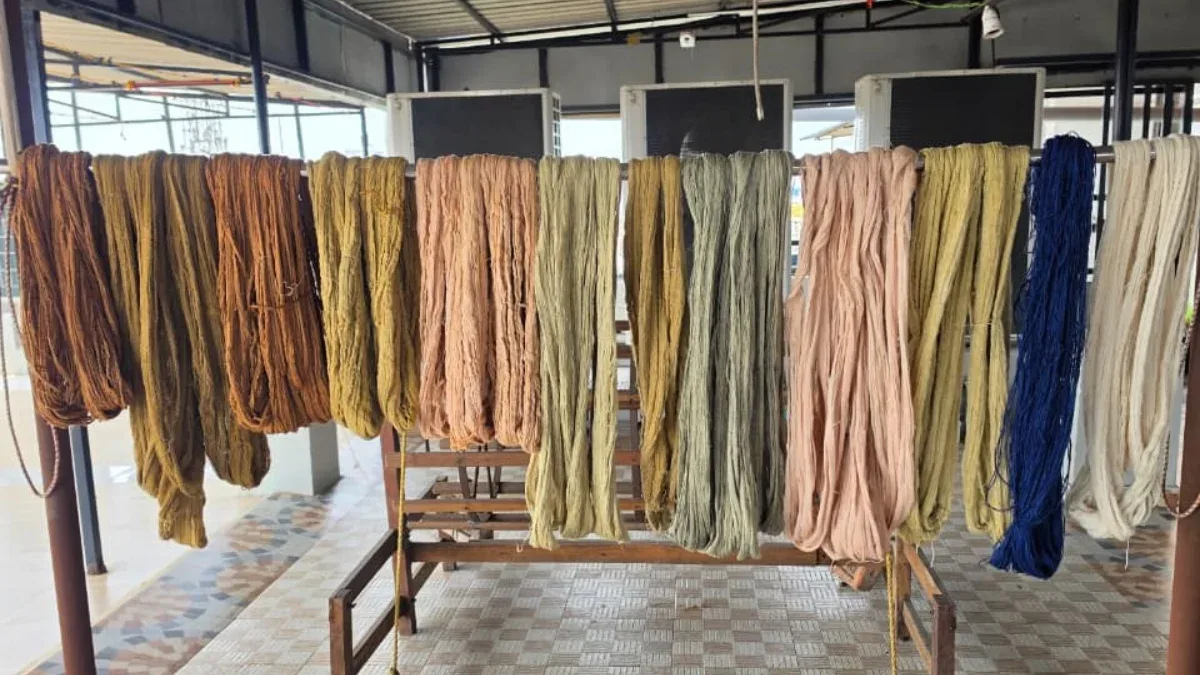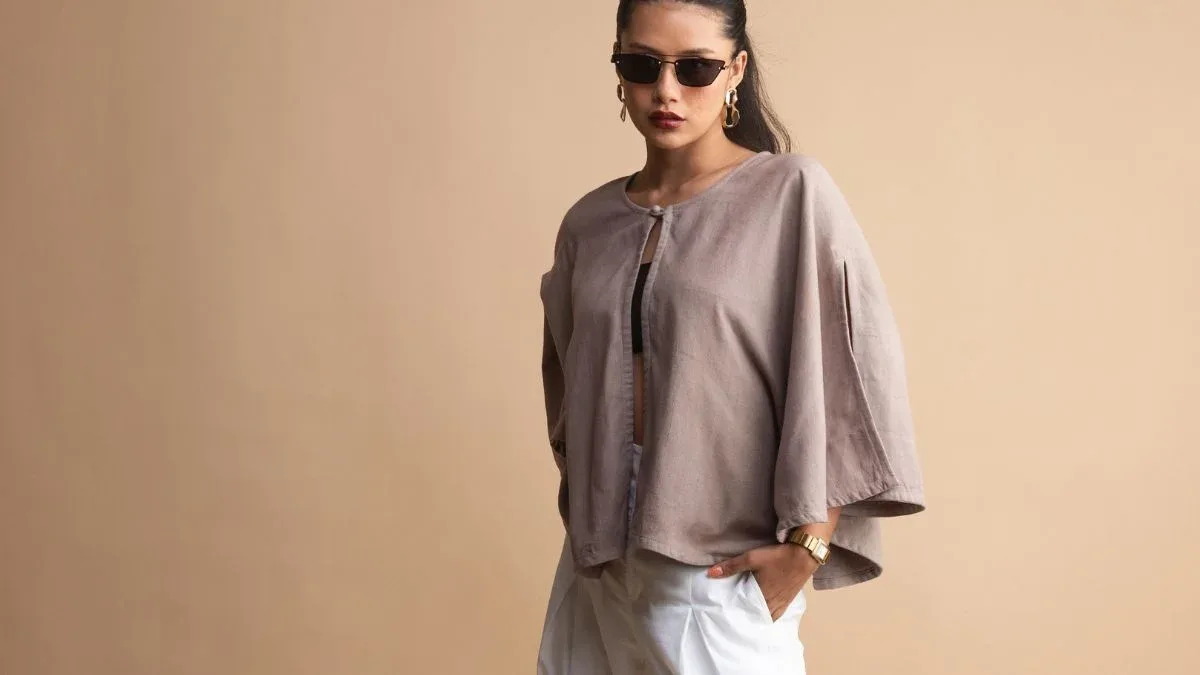
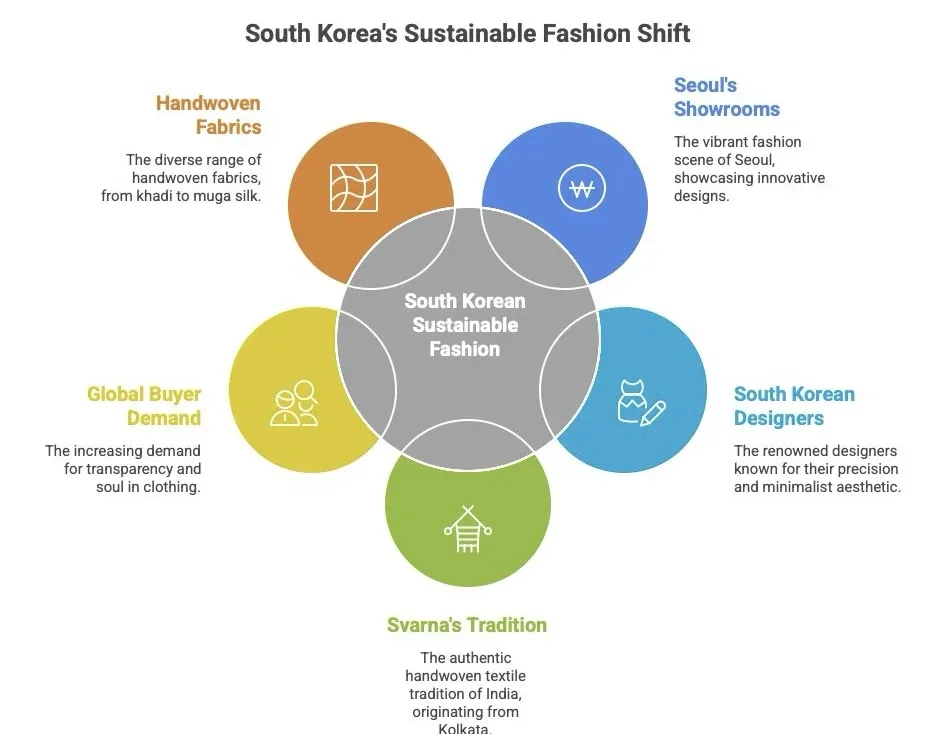
There’s something that quietly speaks volume about the revolution that has been taking place, in the streets of Seoul’s showrooms that showcases fashion largely. However, the South Korean designers, is not only known for its precision, but also the luxe blend with aesthetic minimalism that has been helping in increasing the bypass of synthetic supply and then directly transporting them to the source of origantion which is nothing but Kolkata, where Svarna has been born with its authentic handwoven textile tradition of India. And honestly? It makes complete sense. However, when global buyers have been asking for transparency followed by the accessibility to trace and incorporate soul within their clothing, then is when handwoven fabrics have been born which spans from organic khadi cotton fabric to muga silk fabric which answers for itself like no other fabric supply can.
The Global Pull Toward Slow Textiles
K-fashion has always been about fast-forward thinking that involves nothing but the word emphasized on”forward”, which now means something else in terms of textile fabrics. Now this means “circular” but which depicts nothing but ethics. Therefore, this shows nothing but where your fabric mainly originates from.
What Makes Indian Handwoven Textiles the Fabric of Choice for Conscious Brands
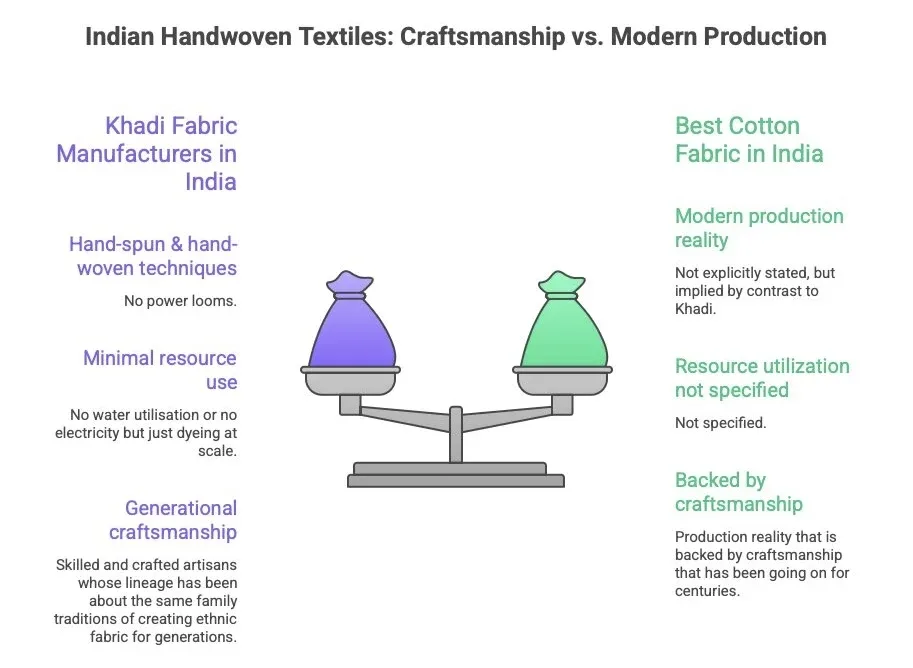
Across the land of global fashion and the conversations, the one pattern that emerges out is the search for the materials, and the raw source from where the material has been made or sourced. This carries both integrity as well as beauty. Khadi fabric manufacturers in India — are skilled and crafted artisans whose lineage has been about the same family traditions of creating ethnic fabric for generations–whihc signifies cloth that had hand spun & hand-woven techniques involved. No power looms. No water utilization or no electricity but just dyeing at scale. The best cotton fabric in India in this category has not been about any marketing claim but just about the production reality that is backed by craftsmanship that has been going on for centuries.
South Korean brands sourcing from these manufacturers aren’t just ticking a sustainability checkbox — they’re accessing a material story that resonates deeply with their consumers. It has been found that Seoul based a slow fashion label has been wrapped around our tradition of craftsmanship showcasing through the tagline “woven by hand in rural India” which is not any exotic marketing technique. It’s the supply chain details of receipts that are demanded by the buyers at large scale as they have consciousness in today’s times.
Platforms like Svarna have been documenting exactly this shift — how sustainable textile sourcing from India is no longer niche, it’s directional.
And if you want to see what this looks like in practice — raw, textural, beautiful — this gives you a sense of the material quality being discussed:
View on Instagram – Svarna Textiles
From Linen Fields to Seoul Showrooms: The Supply Chain Shift
The move is not accidental. Moreover, the Indian Textile producers have been building the infrastructure in a quiet manner to meet the needs of the global buyers which is not accidental. Additionally these infrastructure has also been built to meet the buyer demands from Korea as well and they have been quite a surprise in the present times.
How Indian Fabric Exporters Are Meeting the Demand for Conscious Luxury
However, the changes that have taken place in the last three years are mainly around the infrastructure, and also the storytelling that has been converging. Linen fabric manufacturers in India and linen manufacturers in India who have been invisible previously in regards to East Asian markets, have been findable as well as certifiable and also in terms of shippable. Now, due to skilled artisans and the authenticity of the fabric, the Cotton fabric exporters who has certification and authentic approvals in regards to Global Recycled Standard(GRS) along with handloom certifications have been starting to get inquiries from Seoul buyers, in comparison to past six years ago when this authentic buyers would have gone straight to European mills.
Muga silk fabric — has been extensively just produced through circular fashion technique in the areas of Assam and has been carrying a geographical indication (GI) tag that helps in proving the authentication of its origination in Assam, Guwahati. Moreover, this GI Tag showcases the exclusivity of its production that appears in front of the Korean designers capsule collections which acts as a luxury differentiator. Silk manufacturers in India that have been operating from Varanasi, Murshidabad and also Assam have been receiving export orders from the nearby markets to a great extent, which they have never served previously. Operating in Varanasi, Murshidabad, and Assam are receiving export orders from markets they’d never historically served.
See how circular fashion starts its process at the loom and can start to lead a change in 2026.

Furthermore, the reason why K-fashion brands have been paying attention to the khadi textile fabrics in the present year 2026, is because the consumers have started to notice & read the labels. Koreans have started to notice that Gen-Z consumers pay a lot of attention to the origin of the fibre making sustainability a factor. A garment made from organic khadi cotton fabric sourced from a sustainable fabric manufacturer in India carries a credibility that cannot be replaced easily by any fast fashion brands.
What designers have been finding as soon as they touch the cloth physically, is the handweaving fabrics that don’t just depict a story that is good or can be lived up to centuries but also perform.
As it showcases “how Khadi breathes” and also “How natural drapes of linen have been falling without any sort of intervention”.
Muga silk has a luminosity that no synthetic alternatives can’t even touch or go near to it. This is the reason why contemporary designers are increasingly choosing khadi not as a compromise, but as an upgrade.
See the texture up close – Svarna Instagram
The deeper shift is this: Indian handwoven textiles are no longer positioned as “artisanal alternatives. They’re being recognized as luxury in the truest sense — scarce, skilled, irreplaceable.” And as khadi redefines luxury fashion in 2026, Korean designers are simply early movers in what will become a much wider global realignment.
Conclusion
The relationship between South Korean sustainable fashion and the Indian Handwoven Textiles is not only a trend. But this calls out on the structural shift, that is how brands have started out to be conscious, when it comes to sourcing. This shows that when your fabrics have a face, a region, a technique that defines it—when it is made by skilled artisan hands that use organic khadi cotton or muga silk — it becomes something that even product pages can’t seem to get fully content. Korean designers understand this. And Indian textile makers, from khadi fabric manufacturers to linen manufacturers to silk exporters, are ready to meet that demand with craft that has never needed reinventing.
FAQs
Q: Why are South Korean fashion brands specifically interested in Indian handwoven fabrics?
South Korean brands are drawn to Indian handwovens because of their verified sustainability credentials, natural fiber quality, and cultural depth — elements that resonate with Korean consumers who increasingly scrutinise material origins and production ethics.
Q: What makes organic khadi cotton fabric different from regular cotton?
Organic khadi is hand-spun and hand-woven without power machinery, making it inherently low-energy. It’s also typically grown without synthetic pesticides, giving it a traceable, clean supply chain that mass-produced cotton simply cannot offer.
Q: Are Indian textile exporters equipped to handle international B2B orders from Korea?
Yes — many established cotton fabric exporters and linen manufacturers in India now operate with international certifications, export documentation, and direct-to-brand supply chains, making cross-border sourcing increasingly straightforward for Korean labels.